
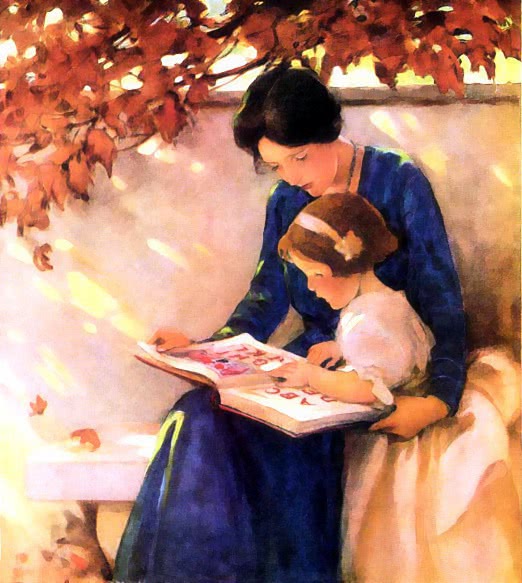
I’m just a big kid at heart because I love picture books as much as any child! There are so many great picture books available, with great story lines, engaging language and delightful pictures. They can be quick to read but invite you to pour over them again and again. They teach children so much about language and life without it even seeming like work. Picture books invite loving interactions between adults and children… What more could you ask from something about ¼” thick that doesn’t have to fed, watered or pottied?
For kids with disabilities, the benefits of picture book reading are magnified. They bring vicarious experiences to kids physically unable to explore the world on their own. They allow children who cannot otherwise experiment with speech to play with language and rhythm and sound. Their colorful illustrations engage wandering attentions and provide visual anchors to abstract concepts. And picture books offer time for nurturing physical contact that isn’t related to medical care—a scarce pleasure for some of our kids with extreme health impairments.
It’s that last point about lap reading that I want to focus on today as we talk about picture books. Another Wednesday I’ll talk about making books independently accessible, but for today, let’s look at how we can make lap reading the fullest experience possible for our kids.
What “ingredients” make for a meaningful lap reading experience? There are the players…a relaxed adult or older sibling, who is willing to give the time needed for an unrushed reading. The reader should be comfortably enthusiastic and animated, keeping the experience interesting and sharing a sense of delight in stories and books. The child should be ready; those who are hungry or cranky will be more distracted than they will be able to immerse themselves in a great book. Then—and this is such an important point—they need to be positioned so they can see! Some kids have physical challenges that prevent them from sitting up and you may need to ask your physical therapist about the best way to set up for suitable “non-lap” lap reading that still promotes physical bonding.
You also need a book…selecting the perfect read is a topic that could fill many posts! But for now, let’s keep it simple. A great book is one your child will love and that you don’t mind reading repeatedly. Remember, typically developing children beg us to reread the same book until we would prefer to hide the thing both have memorized it by heart, and there is important learning and literacy development that is supported by this repetition. We must give our kids with disabilities the same opportunity to request their favorite titles over and over…and over… At the same time, kids need access to lots of books, and thankfully libraries are full of them! Great books have stories that we will remember because of their funny words or awe-inspiring pictures or the way they make us laugh or help us understand our world better.
A book read with an adult doesn’t (usually) have to be adapted to withstand the kind of abuse it might receive if a child was reading it independently. Some kids may still need super-strong or drool-protected books, but often adults get pretty good at pulling delicate books out of harm’s way at just in the nick of time. Children with vision impairments will need some adaptations to give the book tactile information. [I promise, I wrote myself a note so I won’t forget to post on these adaptations another time!]
However, if a child is non-verbal, a book will ideally be adapted so he can talk about it with the reader. While a child able to point may respond to questions by touching parts of the pictures that relate to your questions (“Ooooooh, who is sneaking up behind Max?”), it isn’t easy for him to chime in with the story unless it has some kind of symbol support. Also, not every illustration has all the elements needed for a child to be able to use it conversationally. Symbol support helps with this problem. If you need ideas about how to create communication symbols, check out this post.
For young children, it’s quite fine to provide symbols for just the main actions and characters or objects. Don’t worry about representing little words like “the” or “if” with symbols.

I like to attach little squares of soft LOOPy adhesive hook-and-loop tape (hereafter known simply as "Velcro" to reduce otherwise awkward reading, but any brand will work) to the book itself, as close to the word as I can without blocking the picture or text. The reason that we use the LOOP side in the environment is that it is soft to the touch (I promise, you don’t want to brush a bare arm against the scratchy Velcro hook side when it’s mounted on the wall!). We attach the HOOK side to the cards. If you do this consistently across all environments, you will get a lot more use out of your symbol cards (I saw a classroom once where half the symbols had hook-side and others had loopy-side Velcro. Symbol management was a nightmare, to say the least!).

How do we encourage kids to participate in the book reading and discussion using symbols? If there is a repeating line that comes up regularly, they can tap on the cards each time it comes up in the story. Better yet, record it on a BIGmack or similar voice switch and encourage them to chime in with you when the line repeats.

Hook-side Velcro sticks beautifully to inexpensive indoor-outdoor carpet from the local hardware store. Use a square to hold symbol cards as you read. Peel them out of the book as you go along and stick them on the carpet square to retell the story after the book is finished. Scramble up cards from the story and have your child help retell it in the correct order.


Ask your little reader her opinion about characters and events in the story and let her use the symbols to share her preferences. But do remember, lap reading isn’t about testing…it’s about conversation!!! Keep your questions non-threatening; now isn’t the time for right answers but for ideas and opinions, just as you would expect to talk about books with an adult friend. As children get used to sharing their feedback with you, you will also want to build a set of symbol cards or a board of symbols that allows them to request and comment. You might want to store extra vocabulary that is specific to a certain story right inside the front or back cover (i.e.: “frustrating” isn’t a concept found in enough children’s stories to merit full-time space on most symbol boards, but it might be pertinent enough to a particular story to Velcro a “How frustrating!” card inside the cover for commenting).
While I personally believe every child deserves daily lap reading, as a teacher I realize this doesn’t happen in every home. In schools, we can provide an intimate small group reading experience that comes in a distant second. I’m happy to share ideas to simplify the process if anyone is interested…just let me know!
Enjoy lap reading with your kids this week! The memories you build with your child during these times will bring you both pleasure for years to come.
* * * * * * * * * *
You might also like:
Adapting Books for Physical Access
* * * * * * * * * *
You might also like:
Adapting Books for Physical Access

